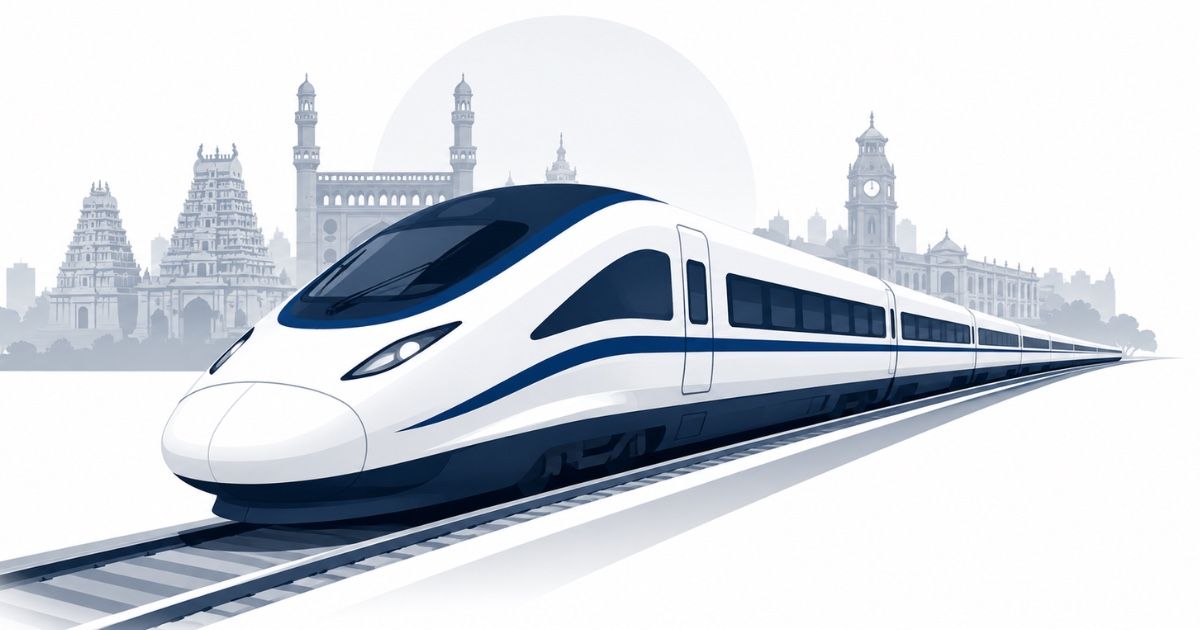
The discussion around a possible Hyderabad-Chennai bullet train corridor has gained strong attention online after reports suggested that a future high-speed rail route between the two major South Indian cities could reduce travel time to under three hours.
The proposal has not yet reached the construction stage, but growing public interest has pushed the topic into national discussion. Transport experts, business groups, and regular travellers are closely watching whether the Hyderabad-Chennai route could become part of India’s expanding high-speed rail network in the coming years.
At present, train journeys between Hyderabad and Chennai usually take between 10 and 14 hours, depending on the service. Flights are faster, but airport travel, security checks, and delays often increase total travel time.
A high-speed rail corridor connecting Telangana and Tamil Nadu could significantly change passenger movement, business travel, tourism, and regional connectivity across South India.
The discussion comes at a time when India is already investing heavily in modern railway infrastructure, semi-high-speed trains, dedicated freight corridors, and metro rail expansion across major cities.
Why the Hyderabad-Chennai Bullet Train Is Trending
The topic started gaining traction after reports highlighted the possibility of a future bullet train link capable of reducing travel time between Hyderabad and Chennai to around three hours.
The idea immediately attracted attention because both cities are major economic and technology hubs.
Hyderabad
- Major IT and startup center
- Growing pharmaceutical industry
- Strong real estate and infrastructure growth
- Large corporate workforce
Chennai
- Automobile manufacturing hub
- Major port city
- Strong healthcare and education sector
- Important industrial corridor
A faster connection between the two cities could support trade, tourism, business travel, and regional economic growth.
Social media users, especially professionals and students, have widely discussed how high-speed rail could change long-distance travel in South India.
Current Travel Time Between Hyderabad and Chennai
Travel between Hyderabad and Chennai remains busy throughout the year.
By Train
Most regular train services currently take:
- 10 to 14 hours
By Flight
Direct flights usually take:
- Around 1 hour and 20 minutes
However, total air travel time becomes longer because of:
- Airport check-in
- Security procedures
- Travel to and from airports
- Possible flight delays
Supporters of high-speed rail say bullet trains can offer city-center-to-city-center connectivity with fewer delays and easier boarding systems.
How Bullet Train Technology Could Change Travel in India
India has already started work on its first major bullet train project between Mumbai and Ahmedabad. The project uses Japanese Shinkansen technology and is seen as a major step toward modernizing Indian rail transport.
If additional corridors are approved in the future, routes such as Hyderabad-Chennai could become part of a wider high-speed network connecting major cities.
Potential Benefits of Bullet Trains
- Faster travel time
- Better business connectivity
- Reduced pressure on airports
- Comfortable long-distance travel
- Economic growth along the corridor
- Lower dependence on road transport
Experts say high-speed rail systems can also help regional development by improving access to smaller cities located between major urban centers.
Possible Economic Impact on Hyderabad and Chennai
The Hyderabad-Chennai route connects two of India’s strongest urban economies.
Business and IT Sector
Hyderabad is home to major IT companies, global technology firms, and startup ecosystems. Chennai also has a strong technology and manufacturing base.
A faster travel corridor could help:
- Corporate travel
- Investor movement
- Startup networking
- Trade meetings
- Technology partnerships
Tourism Growth
Tourism experts believe improved rail connectivity may increase travel between Telangana, Andhra Pradesh, and Tamil Nadu.
Popular tourist areas that could benefit include:
- Hyderabad heritage sites
- Chennai beaches and cultural centers
- Tirupati routes
- Mahabalipuram tourism circuits
Real Estate and Infrastructure
High-speed rail corridors often increase infrastructure development near stations and connected regions.
Property markets near future transport hubs may also witness stronger demand if such projects move forward.
Challenges Facing Any Future Bullet Train Project
Despite public excitement, experts say high-speed rail projects involve major planning, investment, and technical work.
Key Challenges Include
- High construction cost
- Land acquisition
- Environmental clearances
- Long approval timelines
- Technical infrastructure needs
- Passenger demand studies
India’s first bullet train project has already shown that large rail projects require years of planning and execution.
Transport analysts say future corridors will likely depend on:
- Economic feasibility
- Passenger demand
- Government funding
- State cooperation
- Technical studies
At present, there has been no official confirmation regarding construction timelines for a Hyderabad-Chennai bullet train.
How High-Speed Rail Fits Into India’s Transport Vision
India has been expanding railway modernization projects at a rapid pace over the last few years.
Major developments include:
- Vande Bharat trains
- Railway station redevelopment
- Dedicated freight corridors
- Metro rail expansion
- Electrification projects
- High-speed rail studies
The government has repeatedly emphasized faster and more modern transport systems as part of long-term infrastructure growth.
Experts believe South India may become an important focus area for future railway expansion because of its growing urban population and industrial strength.
Public Reaction Across Social Media
The Hyderabad-Chennai bullet train discussion has generated strong public response online.
Many users welcomed the idea of faster travel between the two cities, especially business travellers who regularly fly between Hyderabad and Chennai.
Several users also compared the possible route with bullet train systems in:
- Japan
- China
- Europe
At the same time, some people questioned whether ticket prices would remain affordable for regular passengers.
Others argued that improving existing railway infrastructure should remain a priority alongside future bullet train projects.
What Transport Experts Are Saying
Transport experts believe high-speed rail can offer long-term benefits if projects are carefully planned.
Experts Point to Three Major Factors
1. Economic Connectivity
Faster travel can strengthen business movement between major cities.
2. Regional Development
Cities located along the route may see better infrastructure investment.
3. Reduced Travel Pressure
Bullet trains can lower congestion on highways and airports over time.
However, experts also say India must balance high-speed rail investment with improvements in affordable public transport systems used by millions daily.
Will Hyderabad-Chennai Become a Reality?
At this stage, the Hyderabad-Chennai bullet train remains part of broader infrastructure discussions rather than an officially approved project under construction.
Still, the growing attention around the proposal shows rising public interest in modern rail systems across India.
Large infrastructure projects often begin with feasibility studies, route planning, and government-level discussions before moving toward approval stages.
If future studies support the project, the corridor could become one of South India’s most important transport developments.
Why This Story Matters for Indian Readers
The Hyderabad-Chennai bullet train discussion is not just about faster travel. It reflects a larger shift in how India is planning future infrastructure and urban mobility.
For millions of people, transport affects:
- Jobs
- Business growth
- Education access
- Tourism
- Daily convenience
As India continues investing in highways, airports, metro systems, and rail modernization, high-speed rail remains one of the country’s most closely watched infrastructure ambitions.
Whether the Hyderabad-Chennai corridor moves forward or not, the conversation has already highlighted the growing demand for faster, smarter, and better-connected travel options across Indian cities.
Last Updated on Thursday, May 14, 2026 7:30 pm by E.Devanshi Varma
About The Author